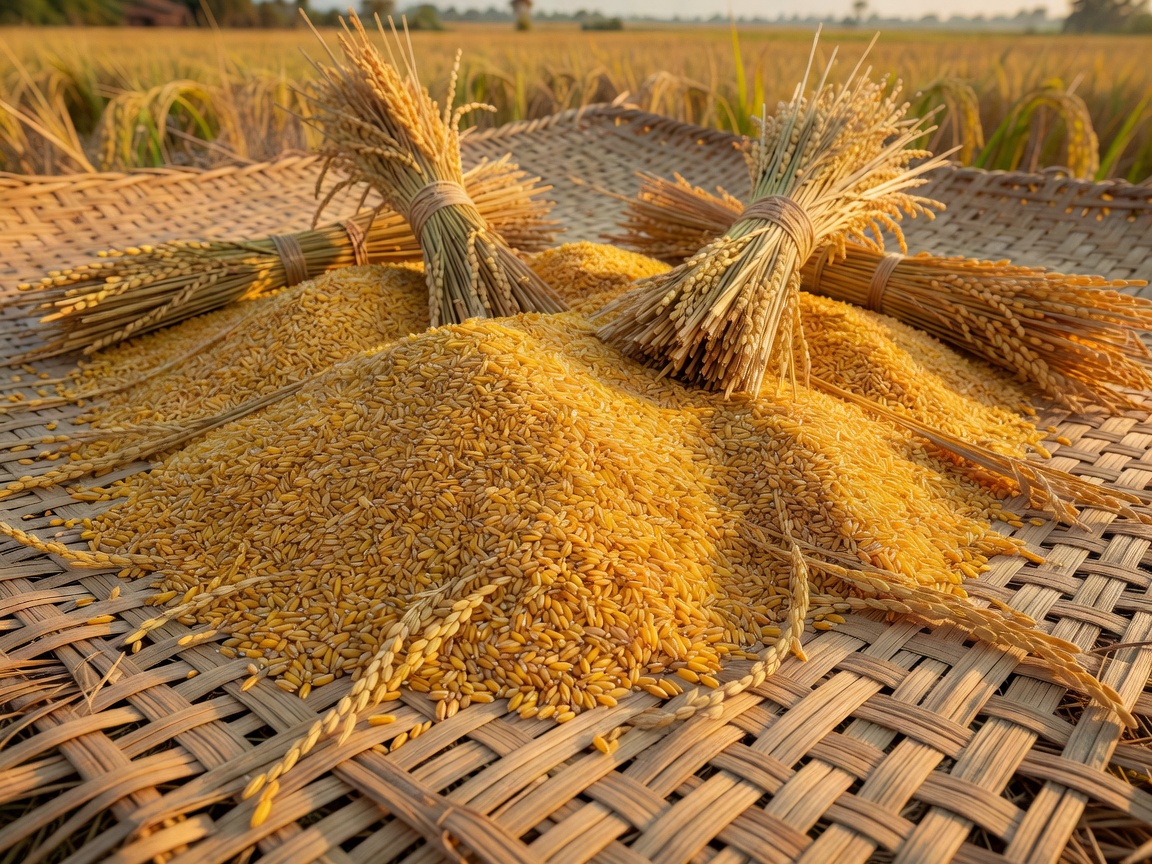
Golden Rice is rice that has been genetically engineered to produce beta-carotene, the plant pigment the human body converts into vitamin A, directly in the grain's edible endosperm — the part of the seed that ordinary rice does not naturally produce it in. It was built to address vitamin A deficiency in populations where polished rice makes up a large share of daily calories and diverse sources of vitamin A are not consistently available. The project is one of the longest-running public-sector GM crop efforts, and it has become a reference point in debates about genetic engineering for nutrition rather than for pest or herbicide management.
- Target nutrient
- Beta-carotene (provitamin A)
- Development began
- 1990s research collaboration
- First cultivation approval
- Philippines, 2021
Who developed Golden Rice, and how long did it take?
The core work was carried out by Ingo Potrykus, then at the Swiss Federal Institute of Technology (ETH Zurich), and Peter Beyer at the University of Freiburg, who began the research in the 1990s with support from public and philanthropic funders. Turning the initial laboratory success into a rice variety that plant breeders in tropical rice-growing countries could actually use took considerably longer than the original engineering step, because the trait had to be bred into locally adapted rice varieties and carried through years of safety and environmental assessment before any government would consider approving it for farmers to grow.
Where has it actually been approved to grow, and where does it stand elsewhere?
The Philippines' Department of Agriculture approved Golden Rice for commercial propagation in 2021, making it the first country to clear the variety for cultivation rather than only for research trials or food safety review. Other rice-growing countries in South and Southeast Asia have at various points reviewed Golden Rice through their own biosafety processes, with outcomes ranging from research approval to continued evaluation; a cultivation approval in one country does not carry over automatically to a neighbouring one, since each runs its own biosafety assessment independent of what others have decided.
How does GM biofortification compare with breeding nutrients in the conventional way?
Biofortification does not require genetic engineering as a method — it can also be done through conventional plant breeding, selecting and crossing varieties that already carry naturally higher levels of a nutrient. The HarvestPlus programme, coordinated through the CGIAR network of international agricultural research centres, has produced conventionally bred biofortified crops such as orange-fleshed sweet potato with higher beta-carotene content and beans with higher iron content, released across a number of countries in Africa and Latin America without needing GM regulatory approval at all. The trade-off is that conventional breeding depends on the target nutrient already existing at useful levels somewhere in the crop's genetic diversity; where that raw material does not exist in a form breeders can cross into a usable variety, as was judged to be the case for beta-carotene in rice, genetic engineering becomes the more direct route to the same nutritional goal.
What other GM biofortification work is underway?
Beyond rice, GM biofortification research has looked at staple crops eaten in similarly narrow diets elsewhere: work on cassava has examined both boosting micronutrient content and reducing the crop's naturally occurring cyanogenic compounds, and research programmes in East Africa have explored biofortified banana varieties given the fruit's role as a staple calorie source in parts of the region. None of this work moves at the pace often assumed for genetic engineering — each candidate variety still has to pass through the same lengthy breeding-into-local-varieties and biosafety assessment sequence that shaped the decades between Golden Rice's laboratory origin and its first cultivation approval.